What is the ASET? The 4 sections of the WA GATE test
What the ASET (the WA GATE test) covers: its four sections, timing, how it's marked and how to prepare, with an example question for each section.
The ASET (Academic Selective Entrance Test) is the test WA students sit when they apply for the Department of Education's Gifted and Talented secondary programs, often called GATE. It has four sections, takes just over two hours including a break, and is done on paper at a test centre. The Department describes it as a test of a student's potential, rather than what they have already learned at school.
This guide explains each section of the ASET, how the test is marked, and how you can help your child prepare, with an original example question for each section.
The ASET at a glance
| Order | Section | Questions | Time |
|---|---|---|---|
| 1 | Reading Comprehension | 35 multiple choice | 35 minutes |
| 2 | Communicating Ideas in Writing | 1 written response | 25 minutes |
| – | Break | – | 10 minutes |
| 3 | Quantitative Reasoning | 35 multiple choice | 35 minutes |
| 4 | Abstract Reasoning | 35 multiple choice | 20 minutes |
That's about 125 minutes in total. Each multiple-choice question has four options, A to D. Timings come from the Department's ASET Handbook, and can differ for students who sit the test under adjusted conditions.
For Year 6 students applying for Year 7 in 2028, the ASET is on Saturday 6 March 2027. See our ASET 2027 key dates checklist for every date.
1. Reading Comprehension
What it tests: understanding and interpreting different kinds of texts: stories, non-fiction, poetry and drama, as well as tables, charts, diagrams and maps. No special subject knowledge is needed. Everything required to answer is in the text.
What it feels like: 35 questions in 35 minutes, so about one minute per question, including reading time. Questions go beyond finding facts: many ask what a character is feeling, why the writer chose a word, or what a table shows.
Example question (our own, ASET-style):
Mia had practised the piano piece every afternoon for a month. On the night of the concert, she walked onto the stage, sat down and rested her hands on the keys. Then she noticed her teacher in the front row, smiling and giving a small nod. Mia let out a long breath and began to play.
Why did Mia let out a long breath?
A. She was tired from a month of practice.
B. She had forgotten how the piece began.
C. She felt reassured and ready to start.
D. She was disappointed by the size of the crowd.
Show the answer
C. The teacher's smile and nod reassure Mia, and the long breath shows her settling before she plays. Nothing in the passage suggests she is tired (A), has forgotten the piece (B) or is unhappy with the crowd (D). Questions like this ask your child to infer a feeling from clues, rather than find a sentence that says it.
Tip for parents: when your child reads anything, from a novel to a news article, ask "How do you think they felt, and how do you know?" It builds the same skill.
2. Communicating Ideas in Writing
What it tests: turning a prompt into an original piece of writing. The prompt can be a picture, some words, or both, and students decide how to respond: for example, with a story, a description or a persuasive piece.
What it feels like: one prompt and 25 minutes to plan and write, by hand. There's no word limit; most responses are one to two pages.
How it's marked: at least two trained markers score each response on qualities such as relevance to the prompt, the originality and interest of the ideas, style, organisation, voice and use of language. Spelling and grammar count for little, as long as the writing can be read. Writing that ignores the prompt is heavily penalised, and pre-written or copied work scores zero.
Example prompt (our own):
The door had never been unlocked before.
A strong response might use that line as the start of a mystery, a memory, or even a door that stands for a new opportunity. Markers reward a fresh take on the prompt over a story about the most obvious idea.
Tip for parents: practise to a 25-minute timer, on paper, with a few minutes of planning first: beginning, middle and end. We'll cover how ASET writing is marked in detail in a later guide.
3. Quantitative Reasoning
What it tests: using maths and science thinking to solve problems, spot patterns and work out relationships between numbers. The questions often look unfamiliar, because they test reasoning rather than topics taught directly in class.
What it feels like: 35 questions in 35 minutes. Calculators aren't allowed, but students can do rough working in the question booklet.
Example question (our own, ASET-style):
A number machine follows the same rule every time. When 3 goes in, 11 comes out. When 5 goes in, 17 comes out. When 8 goes in, 26 comes out.
What comes out when 10 goes in?
A. 30 B. 32 C. 34 D. 36
Show the answer
B. The rule is "multiply by 3, then add 2": 3 × 3 + 2 = 11, 5 × 3 + 2 = 17 and 8 × 3 + 2 = 26. So 10 × 3 + 2 = 32. A good habit is to test a possible rule on every example before choosing an answer.
Tip for parents: puzzles, logic games and "how did you work that out?" conversations help more than extra worksheets of school maths.
4. Abstract Reasoning
What it tests: finding patterns in shapes and using them to predict what comes next. There are two question types: Next in Sequence and Complete the Pattern. No words or numbers are involved, so it doesn't favour strong readers or strong maths students.
What it feels like: this is the fastest section of the ASET: 35 questions in 20 minutes, or about 34 seconds each. Speed and attention to detail matter as much as spotting the rule.
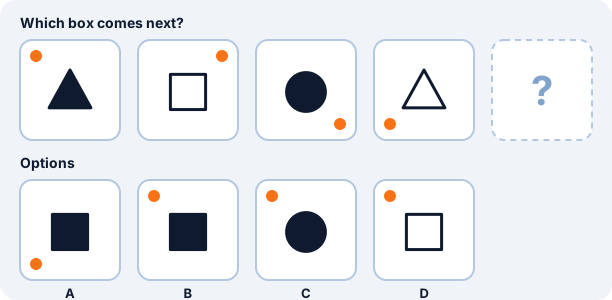
Example question (our own, Next in Sequence):
Show the answer
B. Three things change at once, and each repeats on a different cycle:
- The orange dot moves one corner clockwise each step: top-left, top-right, bottom-right, bottom-left, then back to top-left.
- The shape repeats in a cycle of three: triangle, square, circle, triangle, so next is a square.
- The shading alternates: shaded, unshaded, shaded, unshaded, so next is shaded.
Only B gets all three right. Each wrong option breaks exactly one rule: A leaves the dot where it was, C continues to a circle as if the shapes never repeat, and D gets the shading wrong. That's typical of real abstract reasoning questions: the wrong answers are usually close, so checking every rule matters.
Tip for parents: encourage your child to track one feature at a time (position, shape, shading, size, number, direction) and to rule out options that break any rule. Timed practice matters most in this section.
How the ASET is marked
- One mark for each correct answer in the three multiple-choice sections. The writing is scored by trained markers.
- No marks are taken off for wrong answers, so your child should never leave a question blank. A guess is better than nothing.
- The overall score is what counts. The Department's handbook notes that some students have been offered places despite scoring under half on one of the tests.
- Families receive an ASET Performance Report by email in early June, and Round 1 offers follow in late June.
What to know about ASET test day
- The test is on paper. Multiple-choice answers are shaded in pencil on an answer sheet that is read by a scanner.
- A simple, silent watch is allowed, but phones, smartwatches and calculators are not.
- Watch for skipped questions. If your child skips a question, every later answer can end up in the wrong row on the answer sheet. The Department lists this as a reason families request a review. Practise checking the question number before shading each answer.
We'll publish a full ASET test-day checklist for parents closer to March.
How to help your child prepare for the ASET
- Read the ASET Handbook together. The Department's ASET Handbook explains each section with examples, and its ASET page has a free Practice ASET to try at home.
- Practise under real timing. Knowing how to answer a question is only half of it; the ASET also rewards working steadily against the clock, especially in Abstract Reasoning.
- Write by hand. Do some 25-minute writing practice on paper, since that's how the real test works.
- Keep it calm and regular. Short, frequent sessions over the summer holidays work better than cramming. Practice scores aren't used for GATE offers, and the Department notes they don't predict the real result, so treat them as practice, not a verdict.
Questions parents ask about the ASET
Is the ASET the same as the GATE test?
Yes. "GATE" is the common name for the Department of Education's Gifted and Talented programs, and the ASET is the test students sit to apply for them. All applicants sit the ASET; arts and languages applicants may also have auditions, workshops or interviews.
Can you study for the ASET?
The ASET tests reasoning rather than school content, so there's no syllabus to learn. But familiarity helps a lot: knowing the question types, the timing and how to pace each section means your child can show what they're capable of on the day.
Is the ASET done on a computer?
No. The ASET is a paper-and-pencil test, done at an assigned test centre, not online at home.
How long is the ASET?
About two hours and five minutes: 115 minutes of testing plus a 10-minute break between the writing and Quantitative Reasoning sections.
Does a low score in one section rule my child out?
Not necessarily. Selection is based on the overall result, and the Department's handbook notes that some students have been placed despite scoring under half on one test.
ASET Practice lets your child practise all four ASET sections on a phone or tablet. A Complete practice is 35 questions under the real ASET time limits, and written responses get feedback on criteria like those used in the real test. Find out more about the ASET Practice app.
The example questions in this guide are our own and are not official ASET questions. Test details come from the Department of Education's ASET Handbook and ASET page, checked on 8 November 2026.
Smart Biscuits is not affiliated with the WA Department of Education. ASET Practice offers ASET-style practice questions written by Smart Biscuits.